
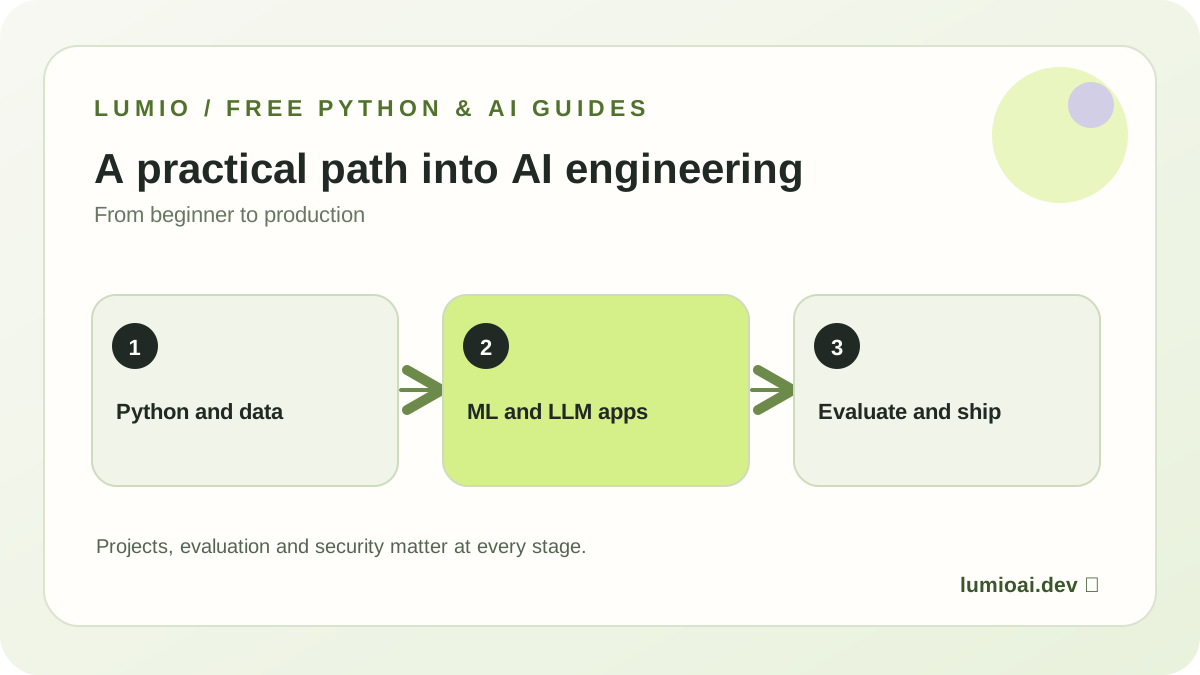
Seven stages of a practical AI engineering journey
Learn Python syntax, variables, control flow, functions, files, testing, Git and basic command-line work. Proof of learning: a small Python program that reads input, handles an error and passes a few tests.
Study descriptive statistics, probability, vectors, data cleaning, charts and experiment design. Learn to notice missing data, biased samples and misleading metrics. Project: a simple dataset explorer with reproducible results.
Explore supervised and unsupervised learning, train/validation/test splits, feature leakage, baselines and evaluation metrics. Use a library such as scikit-learn after you understand the data. Project: a model compared against a simple baseline.
Understand embeddings, gradient-based learning, neural network components, attention and tokenization. You need not train giant models from scratch to understand how they are used. Project: compare embeddings on a small text-search problem.
Build applications with model APIs, prompt templates, structured outputs, retrieval-augmented generation (RAG) and tool use. Understand costs, latency, hallucinations and prompt-injection risks. Project: a question-answer tool over a small, cited document set.
Work with authentication, secure secret storage, monitoring, quality evaluations, rate limits, caching, versioning, observability, and responsible data handling. Project: ship an evaluated service with logs and a fallback plan.
Define a user problem, gather an evaluation set, build an MVP, measure failure cases, iterate, and explain trade-offs in a project write-up. Deliverable: a demonstrable AI system plus evidence of what it can and cannot do.
What makes a project an AI engineering project?
Calling a model endpoint is a start, not the finish. An engineering project should specify the intended user, the inputs and outputs, a baseline, a quality check, known failure modes, operational costs and security boundaries. For example, an AI study assistant might need grounded answers, a way to reject unknown questions, an evaluation set and clear handling of private notes.
A sensible order for beginners
If you are completely new to programming, begin with the 2026 AI engineering from scratch guide for a runnable first project, a 12-week starter plan and practical skill checkpoints.
Begin with a small working Python program, or follow a free seven-day Python-for-AI practice plan with code and tests; then build scripts and data projects. Once you can debug code and explain basic data issues, move into model evaluation and LLM-powered software. Use our beginner project ideas to make each stage tangible.
How Lumio's planned worlds fit
Lumio's current public curriculum preview groups 35 planned worlds and 140 planned build missions into seven themed stages: The First Spark (0–6), The Data Explorer (7–12), The Machine Learner (13–16), The Neural Architect (17–20), The AI Builder (21–24), The Systems Engineer (25–33) and The Final Frontier (34). These are a planned learning path, not 35 publicly available courses. Actual features and coverage may change during development.
How to know you're progressing
Prefer evidence over badges alone. Can you reproduce the result, explain why your first attempt failed, test edge cases, compare two approaches, and show the limitations to someone else? Keep code, a short README, test inputs and screenshots of real outputs. Those artifacts tell you more than a passive completion percentage.
How to measure genuine progress
A roadmap is useful only when you can prove you've learned the skills. For Python, write a function and test it with inputs you haven't seen before. For data, explain how you cleaned a missing value. For machine learning, compare against a basic prediction baseline on held-out data. For LLM apps, track examples of inaccurate answers and measure whether changes improve them.
Start with practical Python exercises, then practice loops and build reusable functions and the rule-based chatbot project. They are modest projects by design: they teach the development habits you'll need before using AI systems in production.