What you need before starting
A computer with Python 3 installed, or a trusted browser-based Python editor, is enough. You do not need paid software, a graphics card, or an AI API key. A phone-based Python environment can work for these examples too. This guide is an immediately usable lesson; Lumio's app-based missions are still in development.
Your first Python program, in four steps
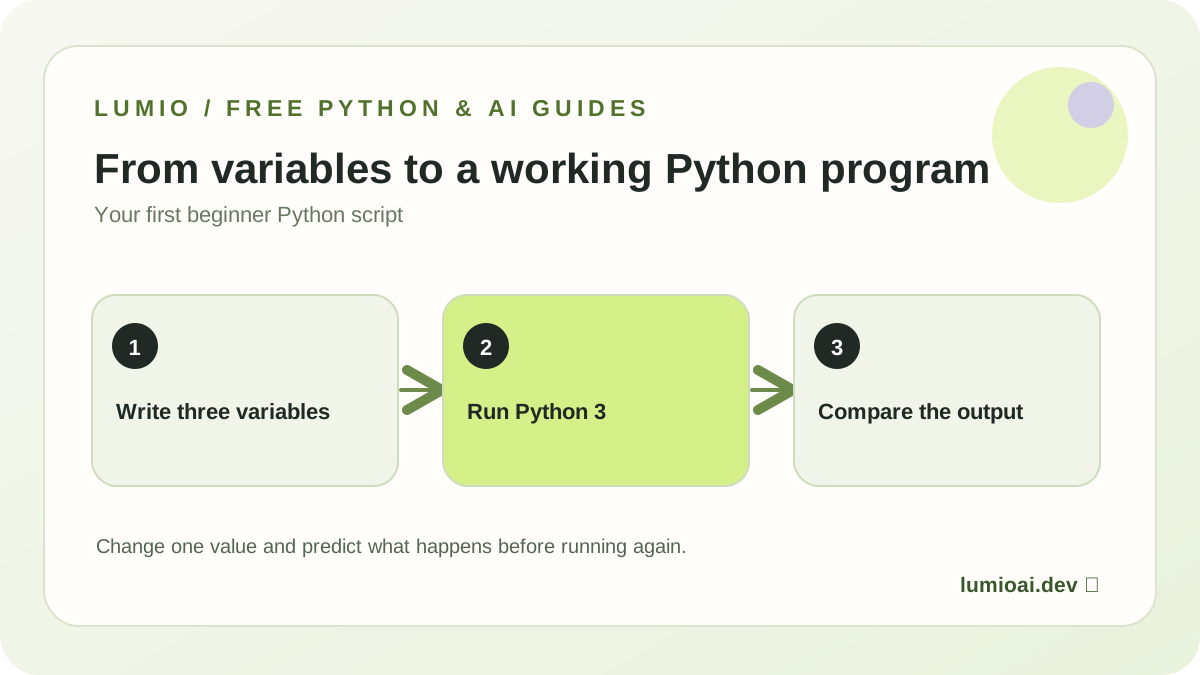
Open a Python editor, create a file called about_me.py, and enter the following code exactly. It prints words and performs one calculation.
# My first Python project
name = "Alex"
goal = "build an AI project"
minutes_today = 15

print("Hello, " + name + "!")
print("My goal is to " + goal + ".")
print("Minutes after two sessions:", minutes_today * 2)
Expected output:
Hello, Alex!
My goal is to build an AI project.
Minutes after two sessions: 30
Python runs these statements in order. The = sign stores a value in a variable; print() displays a value; * multiplies numbers. Unlike text, numbers should not be surrounded with quotes if you want to calculate with them.
Three small challenges
- Change
nameand predict the first output line before running the file. - Change
minutes_todayto 20 and calculate the final number on paper. - Add
print("I showed up today!")as a new line and run it.
Congratulations: you have already practiced variables, strings, numbers, calculations, comments, and program output. Those are real foundations for more advanced work.
Debug one intentional mistake
Try removing the closing quote from a string. Python should report a SyntaxError. Put the quote back and try again. Read the error message and the referenced line instead of replacing random characters. Debugging means making a hypothesis, testing it, and understanding the cause.
What to learn next
After print() and variables, practice input, conditions, lists, loops, functions, files, and modules. Start with Python if, elif and else examples to make decisions. Then use the Python for and while loops tutorial to repeat work, then the functions tutorial to reuse your code. Then use those tools on a small data or automation project. You do not need to learn every Python library before beginning AI concepts.
For a bigger plan, read the AI engineering roadmap, or pick a beginner project with an estimated time. Lumio is planning guided missions from these foundations toward AI engineering, but the app is not publicly released yet.
Practice before moving to AI
Reading code is not the same as writing it. Predict the result of print(2 + 3 * 4), then check your prediction in Python. Practice one deliberate syntax error, read the message and repair just the broken line. Save both versions so you can explain the fix to a friend.
For a paced path, follow our seven-day Python for AI practice plan, from printing output to building a tested keyword retriever. Then work through ten short Python exercises with solutions. When you know dictionaries and loops, try the complete chatbot tutorial. It starts with a small rule-based bot, not an AI model, and shows how to write tests.